
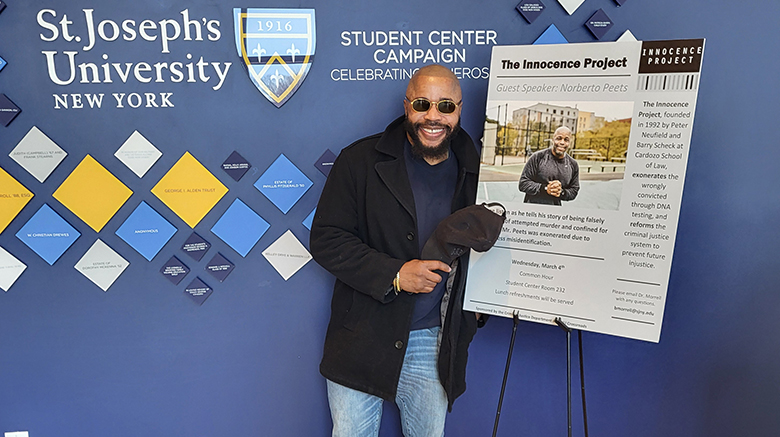
The Story of Norberto Peets
On March 4, St. Joseph’s University, New York’s Criminal Justice Department partnered with the Innocence Project, inviting speaker Norberto Peets to share his experience with SJNY students and faculty. The common hour event was held in the Student Center on the Long Island Campus.
Founded in 1992 by visionary attorneys Peter Neufeld and Barry Scheck, the Innocence Project uses DNA and other scientific advancements to prove wrongful convictions.
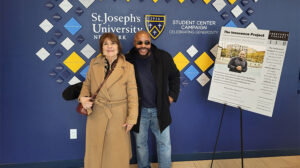
Criminal Justice Professor Barbara Morrell, Ph.D and Norberto Peets.
Peets was arrested on Oct. 6, 1996, after being identified as the gunman of a shooting on Sept. 29, 1996, though he consistently denied any involvement.
During his 1999 trial, Peets and his family testified that he was home that night, but small differences in their timelines weakened the alibi. Despite the prosecutor emphasizing that the gunman had been shot, there was no evidence Peets had a gunshot wound, and his attorney failed to present proof supporting that.
The jury ultimately convicted him for one count of first-degree attempted murder, two counts of second-degree attempted murder and criminal possession of a weapon on May 6, 1999. He was sentenced to 30 years-to-life in prison.
Later efforts to test key evidence like the bullet fragment that is said to have hit the gunman were unsuccessful since the piece could not be located.
A Glimmer of Hope
The Innocence Project began representing Peets in 2010 while investigating his conviction for the 1996 shooting.
“When they accepted my case, I was so happy. I was thinking I was going to come home immediately from DNA evidence,” said Peets.
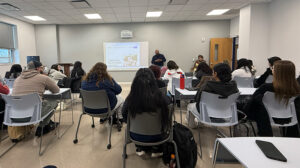
Norberto Peets speaking before a room of SJNY students.
In 2017, the Innocence Project had the Conviction Integrity Unit at the Bronx County District Attorney’s center reinvestigate the case. New evidence showed he was likely falsely convicted due to mistaken witness identification and weak defense testimony. Medical examinations also proved he had never been shot, contradicting testimony about the gunman.
As a result, on May 9, 2023, Peets’ case was dismissed, and he was freed after 26 years in prison.
While convicted, Peets missed major life events like the death of his father and his children’s childhood. During this time, he used basketball as a way to escape.
“When I was playing basketball, it took a lot of stress away from me,” said Peets.
After his exoneration, Peets sued New York City and landed a settlement in 2024.
“I don’t care how much money they give me because I lost too much,” said Peets.
This is not the first time the Innocence Project has worked with SJNY to help the wrongfully convicted share their stories. Previous guest speakers at SJNY have included Carlos Sanchez, Johnny Hincapie, Greg Mingo and Barry Gibbs.
