
Sulabh Katila, the Brooklyn Campus’ valedictorian for the Class of 2026, is a firm believer in going the extra mile. Hailing from Nepal — less than 10 miles from the Himalayas — Sulabh set his sights on moving to New York City to pursue an education in mathematics and computer science with dreams of becoming an engineer.
Finding himself at the front steps of St. Joseph’s University, New York, he was determined to take advantage of the institution’s vast resources as well as the unlimited opportunities offered by living in New York City.
Over the last four years, Sulabh has done just that, serving as vice president of the Computer Club, a peer tutor for SJNY’s Academic Center and volunteering at Boys Hope, Girls Hope — a non-profit organization in Brooklyn — tutoring underprivileged children in mathematics.
Currently working at his engineering internship as he prepares for graduation, Sulabh proudly reflects on his experience at St. Joseph’s and the University’s role in paving his path forward.
OnCampus: What initially led you to attend St. Joseph’s?
Sulabh Katila: I was looking at colleges, doing my research, and I was really interested in people’s individual experiences, so I started reaching out to mutual friends and students on social media. My aunt who was in America at the time introduced me to a student who was attending St. Joseph’s and he recommended that I apply. He spoke very highly of its small yet connected community.
There were two main factors that led me to St. Joseph’s. The first was latency, or the time between action and response. Small class sizes meant less latency and more efficiency. I realized that I could use this to take advantage of the school’s academics more than if I were in a 300-person lecture hall. The same goes for the relationship between peers and professors.
The second factor was location. St. Joseph’s is in New York City and I’m only 20-30 minutes away from Manhattan. This allowed me to attend technical events. For example, one of the events I attended was in the Microsoft offices. I was then able to bring my experiences back to the classroom and apply them to my coursework.
OnCampus: What interested you most about selecting your major?
SK: It’s really the ability to create anything. At the time it was about how I could build things in the most efficient way possible. Computer science attracted me because working with software seemed like the impactful way to do that. Everyone uses software and it’s easy for users to start utilizing the tools that you’ve built.
For mathematics, it goes naturally with computer science. I’m also very much a math guy. I’ve always enjoyed mathematics. That’s why I chose it as a double major.
OnCampus: What were some of your favorite classes?
SK: There was one called “Art of Thinking” which was in no way related to my major or minor. It was held by Professor Burke. It was interesting and exposed to me fallacies, how to construct better arguments and how to spot weak points in other people’s arguments as well.
Another class was “Advanced Programming”. This one was related to my major. I took it my sophomore year. It exposed me to a lot of ideas and best practices related to computer programming. Those were probably my two favorites.
OnCampus: Who are some people who have had an impact on your time at St. Joseph’s?
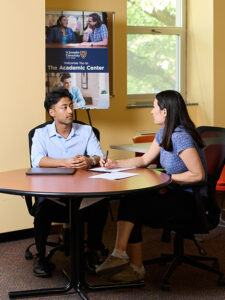
Class of 2026 Valedictorian for the Brooklyn Campus, Sulabh Katila ’26.
SK: One of the first experiences that come to mind was in my first semester. Going into computer science and mathematics, I didn’t have much experience. My goal was to absorb as much material related to my major as possible. I had my classes, but I wanted to learn more.
One of the first things I did was start going to Professor Zamagias’ office hours. She introduced me to a bunch of different topics that I ended up pursuing later. That initial conversation shaped my following years, so I would certainly say Professor Zamagias was influential.
My adviser Professor Zollinger has equally been as influential to me. She has been the professor for many of my math classes as well. She’s always encouraged me and been supportive.
The other person I would say is the international adviser, Dean Larson. Although he’s a professor, my experience with him has been through being an international student.
OnCampus: What have been some of your favorite experiences outside of the classroom?
SK: Many of my most interesting experiences have involved working at the academic center. A few moments that I think about often are my students coming in thinking that they’re not a math or computer person and seeing their mindset change over time.
Last semester, I was working with a student for a statistics class and she scored a 100. I was with another student, and she came in just to tell me. She was beaming. She ended up getting an A and did so well that she didn’t have to sit for her final. Those kinds of experiences have meant the most to me — when my peers come in with an idea of themselves and they leave with a different understanding of who they are and what they can achieve.
Another experience was being asked by the Computer Club to run a technical workshop after I was no longer involved. They saw me as someone who could guide other students on a crucial topic important to computer science. That was certainly an important moment during my time at St. Joe’s.
OnCampus: What does it mean to you to be selected as valedictorian?
SK: I see it more as a responsibility than an achievement. It’s a responsibility to speak from the perspective of every student, to not leave anyone out and make sure that everyone feels seen.
OnCampus: What comes next after graduation?
SK: My career aspirations follow an arc that I’ve thought about carefully. My immediate goal is to fully immerse myself in the world of engineering. I really want to get my hands dirty and be involved in impactful projects. Once I do that, I want to understand myself and what I want to specialize in.
Then, I plan on getting an advanced degree, not for the credentials, but to position myself in a way that enables me to make the deepest impact in that particular field. After the degree, the next goal would be making meaningful contributions to society, whether it’s through a company I’ve built or from a role that I grow into.
Finally, this arc ends in academia. I would want to be a professor in computer science or some other technical field.
OnCampus: How do you feel your experience at St. Joseph’s has prepared you for your next steps?
SK: I feel very prepared. There are many technical skills I would need to get involved in the world of engineering — understanding how to build software, how to maintain software and how to work it. All of my classes have given me the mental framework that would be advantageous in any scenario. And I’ve already experienced it. These are all skills that I’ve used in my internships. I know they will be just as impactful in my life post St. Joseph’s.
The second thing would be the soft skills like leadership. St. Joseph’s has given me the opportunity to assume leadership roles whether it be in the Computer Club, or allowing me to lead technical workshops and other events. From a communication aspect as well, working at the academic center.
OnCampus: What advice would you give to incoming students?
SK: Don’t be reluctant to take classes that don’t fall under your major. I found a lot of value in classes like “Art of Thinking.” Another piece of advice is to not shy away from responsibility. Just because you haven’t done something before doesn’t mean that you can’t take responsibility, believe in yourself and accomplish the task.
This story is part of OnCampus’ “Class of 2026 – Meet the Grads” series, focusing on the Class of 2026 at St. Joseph’s University, New York. To read more from this series, click here.
