For the summer of 2025, 10 students were selected for the Summer Undergraduate Research Fellowships (SURF), an SJNY-funded undergraduate research program that provides stipends of $4,000 for each student recipient to work on research projects, overseen by a faculty mentor.
With an overarching goal of alleviating the economic pressures that can prohibit strong students from actively engaging in academic research opportunities, the SURF program is open to students of all disciplines. Recipients conduct their research for 10 weeks over the summer and then present at the Student Research Symposium the following spring.
The Impacts of Coastal Acidification
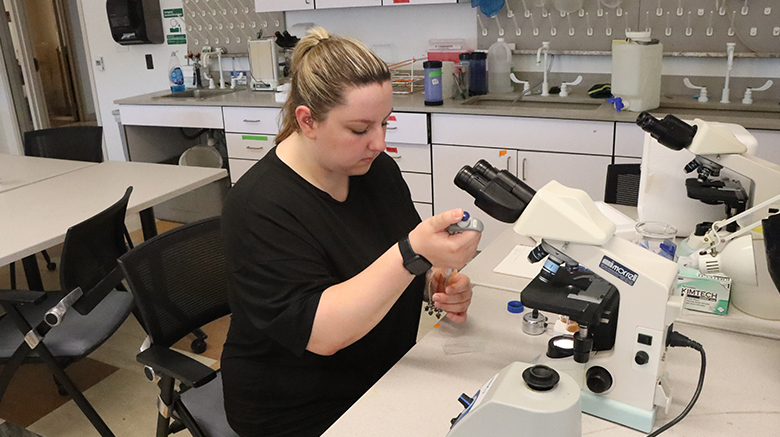
Long Island biology major Alison Monaco ’26 was selected to conduct research on the impacts of coastal acidification on behavioral responses to prey cues in Cyprinodon variegatus. With mentorship from Konstantine Rountos, Ph.D., associate professor of biology on the Long Island Campus, Monaco studied the sublethal, non-fatal impacts that exposure to harmful algal blooms (HABs) and coastal ocean acidification (COA) conditions can cause to marine organisms at the Stony Brook Marine Station in Southampton.
“I am so grateful to have been offered this opportunity to be a part of the SURF program,” said Monaco. “I was able to broaden my research experience and see what topics I am truly interested in and to not only experience research, but also the preparation and maintenance of a scientific experiment of this level.”
SURF recipient Alison Monaco ’26 and faculty adviser Konstantine Rountos, Ph.D.
For much of the time that Monaco spent on her research, she focused on caring for the forage fish after the exposure to HABs and COA. By following specific protocols and procedures from the Institutional Animal Care and Use Committee to ensure ethical treatment, she assessed fish that were six weeks posthatch while also assessing water quality, cleaning the habitat, harvesting their food and feeding them, along with various other tasks as she waited for the fish to reach optimal age for her experiments.
“It is known that when a fish picks up the scent of a possible food source, they will likely be attracted to that area,” said Monaco. “I am questioning if the exposure to HABs, specifically Cochlodinium polykrikoides, and COA conditions or environments with elevated CO levels, will impair a sheepshead minnow’s ability to properly respond to the presence of prey cues.”
First-of-its-Kind Research
Commonly associated with eutrophication, or nutrient pollution, which can be caused by fertilizer runoff or sewage drainage into coastal habitats, Monaco was assessing the influence on animal behavior, referred to as the field of ethology.
“Our marine environments are experiencing a variety of stressors, largely at the hands of human activities,” said Dr. Rountos. “This research is the first of its kind and will establish a better understanding of how exposure in early life stages of fish to some of these stressors may impact their future ability to avoid predators or find prey later on in life.”
Drawn to ethology and curious to learn how an environmental condition can alter behavior in an organism’s day-to-day life, Monaco hopes that her research will help other researchers gather an understanding for how the fitness of an organism can be impaired by anthropogenic influences, such as eutrophication.
“I love the idea that there is truly so little known about our oceans,” said Monaco. “Marine biology is such a broad subject, encompassing such a wide range of unique organisms and I think that is what causes me to gravitate towards studying aquatic life.”
“The SURF program is an extremely valuable program that supports our highly motivated SJNY students,” said Dr. Rountos. “Without this program, many of our brightest students would not be able to immerse themselves fully in a summer research project.”
This story is part of OnCampus’ “SURF Recipients 2025” series, centered on students conducting research at St. Joseph’s University, New York in anticipation of the University’s 2026 Student Research Symposium. To read more from this series, click here.