
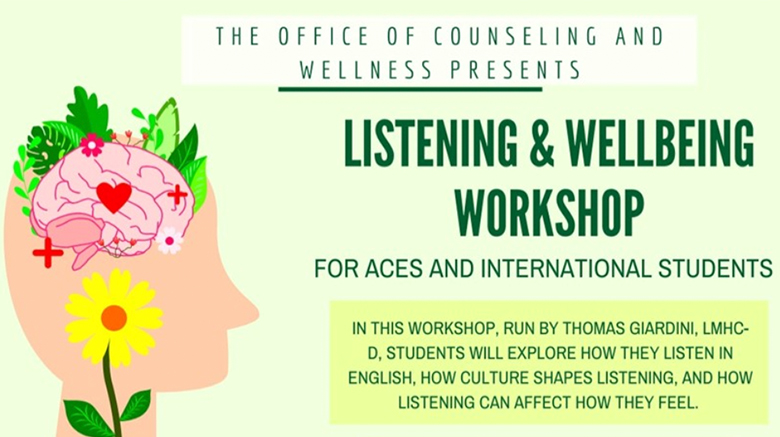
On Tuesday Feb. 10, students gathered in St. Angela Hall for a discussion hosted by the Office of Counseling and Wellness. The Listening and Wellbeing workshop was hosted by licensed mental health counselor Thomas Giardini and was geared toward ACES and international students attending St. Joseph’s University, New York.
The event’s purpose was to help students explore how they listen in English, how culture shapes their communication and how listening can affect how they feel. The workshop invited students to reflect on their own experiences—from the sounds of home to the challenges of speaking and processing a second language.
The conversation began with a simple yet powerful question: What is the difference between hearing and listening?
“We all have ears. It’s pretty hard to turn them off,” Giardini told students. He emphasized that hearing happens naturally, but listening requires focus and energy.
Insightful Discussions
The students were asked to think about the sounds that remind them of home. Some mentioned the sound of traffic and car horns in Brooklyn. Others spoke about their native homes, markets filled with people calling out services, family members talking over one another and even the noisy pipes in their apartment building.
“You don’t realize how much you’re hearing until you’re outside of it,” Giardini said.
The discussion then shifted to how students are able to tell when someone is truly listening. The students mentioned eye contact, facial expressions and thoughtful responses as characteristics of a true listener. Others shared that remembering details from previous conversations is also a sign of true listening rather than taking words “in one ear and out the other.”
A lot of the conversation was centered on the experience of speaking English as a second or third language. Students explained how time-consuming it is, having to translate what was being said, process the grammar and predict the meaning before responding. Many of the students described the process of listening in English, stating that it requires focusing on information first before acknowledging any emotion.
“It’s a lot of energy,” one student explained. “You translate in your mind, process it and then think about how to say it correctly.”
Students also spoke about how tone, accent and pronunciation can change how their words are interpreted. Some shared that focusing on the context instead of individual words helps them to listen more effectively. Other students shared that asking those they are speaking with to repeat themselves helps as well.
A Safe Space
The workshop concluded with a light reflection: what music do students listen to for enjoyment? The ACES students shared that they love to listen to music in English. Others mentioned listening to podcasts instead, which were most enjoyable for them.
The session gave students a space to share their experiences with language and communication, and connect through similar experiences. Students walked away with a deeper understanding that listening is not just passive, but also cultural and intentional.
